If you would like to add edibles to your landscape without having to work in the yard every weekend, you may want to think about muscadine grapes. Muscadine grapes are native to our area, are well adapted to Sampson County, and are relatively pest free. With a little pruning, fertilization, and observations, you can grow a relatively good crop of grapes and enjoy your harvest in late summer.
Muscadines can be grown for fresh eating, making jellies and jams, or for juice or wine. The variety selection is dependent on the end use because the best grapes for eating aren’t the best for wine making and vice-versa. Fresh eating varieties include Supreme, Paulk, Triumph, Tara, and Fry. Supreme and Fry are female vines which means they won’t produce fruit unless they have a pollinizer vine nearby. Luckily, Paulk, Triumph, and Tara are self-fertile and can be used as a pollinizer. Wine or juice varieties include Carlos, Noble, and Magnolia.
Once you decide on an end use and a variety, then select a site that has full sun and is at least 50’ from tree lines. Take a soil test and make sure that your pH is near 6.5. Trellis your grapes on a single wire trellis 5-6 feet above the ground and keep the area under the trellis weed free. Fertilize according to the vines age. Apply ¼ pound of 6-6-18 fertilizer per vine after planting and 4 weeks later in year one. Supplement with 1 cup of 15.5-0-0 during the second application of fertilizer. In year two, increase the fertilizer to ½ pound per vine and supplement again with the same rate of 15.5-0-0. In year three, the vine is considered mature. Mature vines need 2-3 pounds of 6-6-18 in March and June. Do not fertilizer any vines after July 4th.
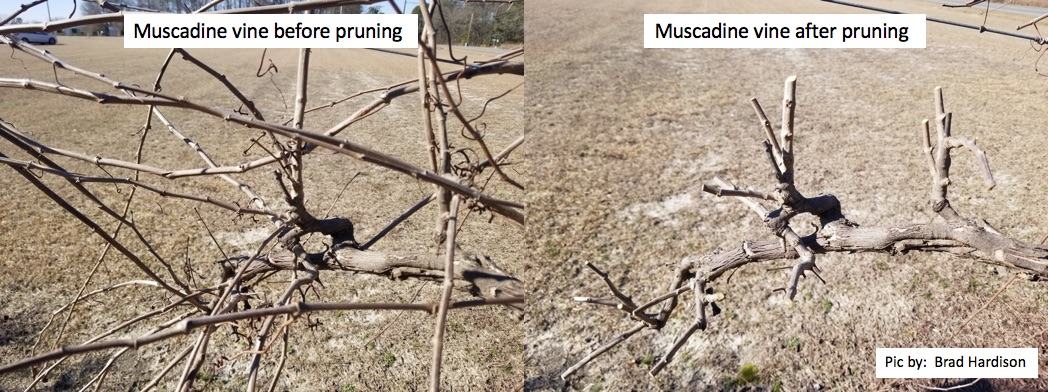
Grapes need pruning in January and/or February. Prune vines back to 1-2 buds on last year’s growth. Remove any weak wood that is smaller diameter than a #2 pencil and repeat every year.
The biggest issue with grapes is the failure to prune. Mature vines left unpruned can become a tangled mess of unproductive wood which causes less yield and smaller fruit. Many people get scared when pruning grapes because you remove a lot of growth off the vines, and leave what many describe as a plant skeleton. Grapes produce a lot of new growth each year, so don’t be afraid if the removed wood begins to make a big pile.
Another issue with grapes is that female vines are planted and there is no pollinizer vine to pollinate the flowers, resulting in no fruit. Varieties such as Supreme, Fry, and Darlene are female varieties that must have a pollinizer vine planted within 100’. I have seen several cases of homeowner vines suddenly stop producing grapes because the pollinizer vine had been removed.
The last major issue for grapes is herbicide injury. Grapes are not tolerant to any herbicides sprayed near them. Make sure you or your landscape company leaves a large buffer when spraying your lawn for weeds. Drift and root uptake can severely affect grapes if they come in contact with herbicides.
You can find more information on growing grapes in the home landscape from NC State Extension.