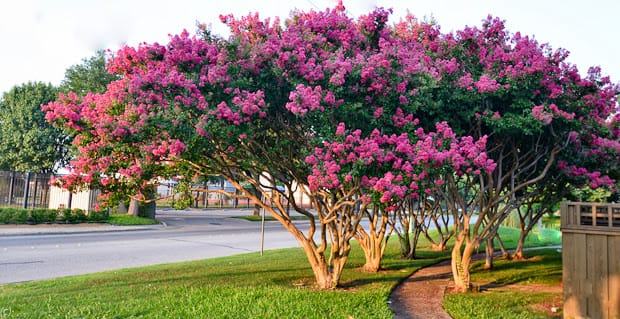
The Crape Myrtle (Lagerstroemia indica) is a flowering tree or shrub that is native to Asia. It was introduced into the United States in the early 19th century and gained popularity in the southern United States due to their ability to thrive in our warm climate. It is commonly referred to as the flower of the South because it blooms from July to September during a time when most other plants are not blooming. The terminal blooms are panicle and measure from 6 to 18 inches in length and vary in color from rose to red, white, pink, mauve, lavender, purple, yellow, and orange. The flowers are numerous, irregular and look like crepe paper.
Crape myrtles are also renowned for their visually appealing multi trunks and exfoliating bark. The bark starts out as gray, but then peels and exposes a smooth, vari-colored under bark ranging from browns, cinnamons, oranges, and burgundies.
Crape myrtle is ideally suited for formal or informal design in the home landscape, street plantings and community plantings. It can be planted as a specimen or in groups, and looks attractive when underplanted with a ground cover; the dark green of the groundcover contrasts well with the handsome bark.
It adapts well to confined spaces, and is therefore, well-suited for small areas close to sidewalks or parking lots, and can provide shade in deck and patio areas. The flowers of some selections, however, may stain car paint, and the honeydew drops from aphids on the plant may stick on cars or patio furniture. As cultivars are now available in a wide range of growth heights, certain selections can be used under utility lines without fear of interfering with these lines. Cultivars under 10’ tall include Cherokee, Victor, Chickasaw, Caddo, and Pecos. Cultivars between 10-15 feet tall include Carolina Beauty, Catawba, Acoma, Comanchee, and Sioux. Cultivars from 16 to 20 feet tall include Seminole, Potomac, Apalachee, and Powhatan. Cultivars from 20 to 30 feet tall include Tuscarora, Wichita, Choctaw, Muskogee, and Natchez.
Plant crape myrtles in late fall to early spring. Late fall gives the plant time to grow strong roots and establish itself before it has to use its energy for leaf and flower production in spring. The ideal planting site is in well-prepared, well-drained soil, with full sun exposure and good air circulation. Crape myrtles planted in partial or full shade will have reduced flowering and increased disease susceptibility. The plant will tolerate slightly alkaline to acidic (5.0 to 6.5 pH) clay and other soil textures. Although it tolerates drought, it requires irrigation until it is well-established (approximately two years). This is especially true when it is planted in confined areas. Heavy nitrogen applications cause the plants to flower less and produce shoot and leaf growth that may be subject to winter injury. Light applications of a complete fertilizer in spring and summer are adequate.
Severe pruning of crape myrtles has become a common practice to maintain shrub size. This ruins the natural, graceful effect of the plant. Many dwarf and semi-dwarf cultivars are now available, making it possible for the homeowner to have the desired plant size while maintaining the natural branching effect.
Powdery mildew is a common problem with crape myrtles. It is most common during spring and fall when leaves and new shoots are found coated with a powdery, white mold, and become distorted. Powdery mildew can be managed by using fungicides such as Eagle, Immunox, Funginex or Banner Maxx. Another issue with crape myrtles is aphids and bark scales, which are small insects that feed on the plant sap. Aphids and scales can be managed by using horticulture oil anytime the pest is identified.
For a list of crape myrtle cultivars, sizes, trunk and flower color check out the cultivar list to help with your selection.